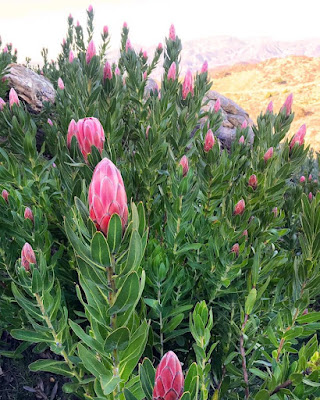
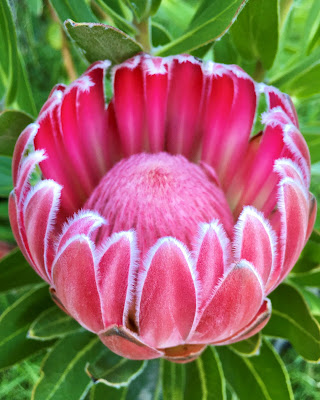
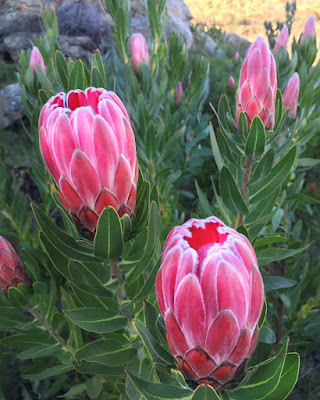
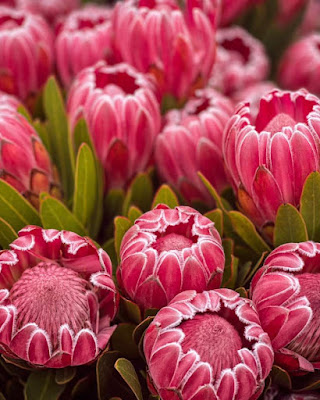
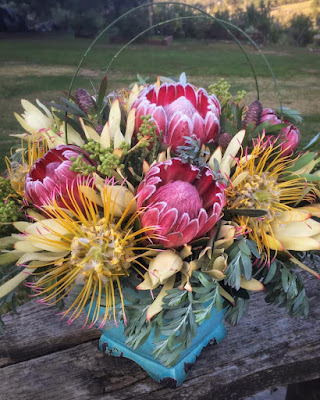
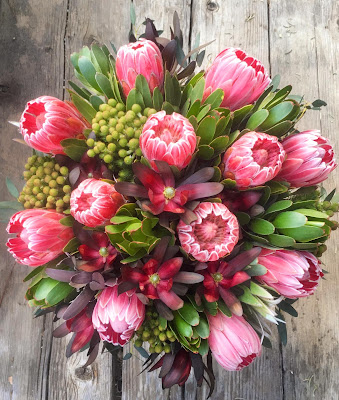
Spring is a long way off, but if you could use a winter pick-me-up, we have the perfect antidote. Pink Duke… a bright, cheery and vibrant protea. This lovely cultivar produces large, rose-pink blooms with a light pink central dome and white feathery tips. Pink Duke has the soft green leaves of the P. magnifica (queen) and the clear velvety, pink flower of the P. Trish Compacta.
Pink Duke blooms winter through early spring, delivering a bounty of beauty, love and joy from new years, right into Valentine’s Day.
There is no doubt that Pink Duke brings an abundance of winter cheer in the fields. But once harvested, arranged, and mixed with an array of other gorgeous florals, they are simply contagious!
Spring may be a long way off, but if you could use a winter pick-me-up right this minute, we have the perfect antidote. A gorgeous protea cultivar that’s certain to boost your spirits and take the chill out of a cold winter day.
Trish Compacta! Think Pink and so velvety soft (don’t you just want to reach out & feel those satiny petals?). This protea is a wonderful mix of compacta and laurifolia with the classic flawless-colored floral bracts in a rich pink (like compacta) and silvery-white highlights that surround the same pink colored center dome. Trish Compacta blooms winter through early spring… which means you should be enjoying them, umm right now!
When harvested and mixed with other proteas (and some textural Berzelia), there’s no doubt Trish Compacta delivers nature's best remedy to cure the winter blues.
Leucadendron Inca Gold, please! Because who doesn’t love a burst of sunshine on a cold winter’s day!
This popular cultivar bred in Australia during the 1990’s is believed to be a hybrid of L. laureolum and L. salignum yellow. The rich buttery-yellow flowering bracts with red tips do not open wide like many other leucadendrons as they tend to keep a closed tulip-like shape. Inca Gold are at their peak for color and harvesting during the early winter and make a breath-taking addition to bouquets and arrangements.
Few things look more exhilarating during these cold winter days of January than a bounty of gorgeous Protea Trish Compacta, in bloom… stretching high up in the sky on long, sturdy stems against a scenic backdrop. Their bright, vibrant flowers and lush, green foliage certainly have a way of taking the ‘chill out of the air’!
Yes, bring on the Protea Trish Compacta! Think Pink and so velvety soft (don’t you just want to reach out & feel those satiny petals?). This protea cultivar is a wonderful mix of compacta and laurifolia with the classic flawless-colored floral bracts in a rich pink (like compacta) and silvery-white highlights that surround the same pink colored center dome. Trish Compactas bloom winter through early spring… which means you should be enjoying them, umm right now!
When harvested and mixed with other proteas (and some textural Berzelia and eucalyptus), there’s no doubt Trish Compacta can take the chill out of any winter day.
The protea fields are more colorful this fall thanks to 'Grandicolor’.
A cross of P. grandiceps and P. aurea, this hybrid cultivar from Australia combines features from both parent plants in a unique combination. The greenish-cream bracts, which deepen to tan at the base, have a delicate pinkish rim and conspicuous hairs like the grandiceps and surround rusty-red centers. The egg-shape foliage is small and leathery with a silvery-green hue and the stems straight and upright like the aurea. Grandicolor produces dainty, medium sized blooms off and on from autumn through spring.
It’s officially ‘Safari Season'! Often one of the first hints of the season in our fields... leucadendron Safari Sunset serves as a gauge for warmer and longer days. These barometers of summer begin to emerge as spring winds down, revealing their deep-red bracts and long stems from July all the way through October.
There’s no doubt, Safari Sunset is the most well-known leucadendron, with millions of stems being grown in numerous countries around the world. A New Zealand raised hybrid cultivar, this mix of L. Laureolum x L. Salignum has proven the importance of crossbreeding in the protea industry.
Like a burst of color in the field, Safari Sunset brings a rich look to floral designs as well. Stunning no matter how you display it, this leucadendron looks great when blended with an array of flowers and greens or even used as a focal flower in boutonnieres. Here are some wonderful ways you can enjoy this fabulous foliage during the summer and well into fall.
These chic flowers are all style… or perhaps better said, all styles. In other words, their lively, round heads are formed mainly by the long, sprout-like structures, each one ending in a globular knob called a pollen presenter. Together, the mass of styles look a lot like pins bristling from a “pincushion”, a similarity that has given rise to the popular name for this genus.
So appropriate is the name “Pincushion Protea” that it has in fact replaced the original South African name of “Luisies” which refers to the grayish-white, rounded seeds found crumpled in the dried flower-heads.
Leucospermum comprises some forty-eight species, of which all but three are endemic to South Africa’s Cape Province. Flowering time is generally early winter through late spring. Unlike flowers of the genus Protea, which rely on their showy bracts for visual appeal, leucospermum put all their art into the colors of the flowers themselves as well as the flowing shape of each curving component.
In the 1970's the University of Hawaii’s Protea Research Project started working on an exclusive collection of new and improved cultivars of pincushions. The goals were aimed at improved color, increased vase life and good stem length. The results - some amazing and gorgeous hybrids, many of which have quite complex ancestry, some with even ten species parents.