Showing posts with label Cape Floral Kingdom. Show all posts

Tuesday, July 22, 2025

Aristata: Christmas Sugarbush


With large, crimson blooms and fine, needle-like foliage, it’s no secret why aristata is affectionately known as the Christmas Sugarbush. Whether you enjoy the vibrancy of a deep-red flower or the festive charm of a pine tree, this protea delivers holiday vibes in the summer.


Aristata is endemic to a small section of the southern Cape Province, near the town of Ladismith. It’s part of the fynbos biome, a rich and diverse ecosystem that is one of the most biologically unique floral kingdoms in the world.

The name aristata comes from the Latin arista, meaning “bristle,” referring to the plant's fine, sharp-tipped leaves. Its common name, Christmas Sugarbush, reflects its habit of blooming in November through January, right around the holiday season in the Southern Hemisphere. Yes, aristata may sound like it should be wrapped in lights, but here in California, it blooms in June and July… bringing a merry-and-bright “Christmas in July” energy our to fields.


Aristata delivers a bold statement of nature's unmatched creativity, bursting with texture and perfect for designing. From stunning bouquets to elaborate centerpieces and displays, these amazing blooms add a festive twist to designs. Their ability to adapt to various themes and arrangements, paired with its long-lasting nature, offers a versatile tool for creating striking, meaningful displays. Whether it’s a Christmas or Independence Day theme… aristata is sure to bring a touch of exotic elegance to any summer decor.


Wednesday, January 31, 2024

Berzelia Berries


Looking for stems of beautiful berries for cut flower bouquets, arrangements or even wreaths? How about using Berzelia or often referred to as Buttonbush? Clusters of round-shaped flowers adorn these lush evergreen plants, complemented by soft, fern-like foliage that surrounds the entire stem from top to bottom in a spiral-like design.


Berzelia lanuginosa


Berzelia Red Jelly

These ‘other-worldly’ botanicals flower from early winter and last well into spring. The berries are often massed in spherical heads and range in color from several shades of green, yellow, creamy-white and some varieties are even two-toned. Berzelia’s unique texture not only appeals to your sense of sight, but also to your tactile senses. Whether it is the lanuginosa or Red Jelly variety, these berries are certainly engaging, making you want to just reach out and touch them. It’s easy to see why this amazing botanical has become popular among designers around the world for its exotic appearance and fabulous texture that complements a range of stylist moods.


Berzelia, is one of approximately eight species found in the Bruniaceae family, one of the few families that is endemic to the Cape Floral Kingdom. It grows naturally in the wild from the northwestern to the southwestern parts of the Western Cape.

Friday, July 28, 2023

Fynbos


Fynbos is one of the earth’s hot spots because of its exceptional biodiversity. It’s little wonder that Fynbos which literally means ‘fine bush’ has been touted for its unique type of vegetation that accounts for more than 80 percent of the plant species in the Cape Floral Kingdom. And, more than two-thirds of these plant species are not found growing naturally anywhere else in the world (like Mimetes pictured above). Many of these amazing plants have been used for their decorative and gardening purposes, medicinal purposes and even their magical powers. Despite the growing interest in fynbos, it remains a mystery to many people. Some species can be found growing right under their noses and they don’t even realize it.

Fynbos is composed of approximately 100 families with the three largest and most well-known families being: the ericas, proteas and restos. With that in mind, there are plenty more families to get to know – Here are just a few of our favorites:


Agapanthus means ‘Flower of Love’ and is derived from the Greek agape’ meaning ‘love’ and anthos meaning ‘flower’. They are also known as the ‘lily of the Nile’ and the ‘African lily’ even though they are not a lily. Did you know in the world of magic the agapanthus is a highly respected plant? The roots can be used to make a love charm and their magical powers even ward off thunder. And agapanthus can serve as a fire-break if you plant it close enough to the house.


Egyptians called the aloe vera plant “plant of immortality,” 6,000 years ago. Cleopatra applied the moist middle of the spiky plant to her body as part of her beauty regimen. Greeks used it to cure everything from baldness to insomnia and the Native Americans called it the “Wand of the Heaven.”


Leonotis leonurus is also known as wild dagga and lion's tail. Wild dagga flowers and leaves were smoked by the Hottentot tribe of southern Africa because of its euphoric effect. In traditional healing, wild dagga is used to treat fevers, headaches, coughs, and skin rashes. It's also used as a charm to keep snakes at bay and has been used to treat snake bites.


Tulbaghia Violacea or wild garlic is also called Society Garlic because Dutch settlers thought it was a more polite spice to use for flavoring dishes than true garlic particularly for social events. And the Zulu used both the flowers and the leaves to make hot seasoning with meat and potatoes. Tulbaghia is a disinfectant, and the bulb has been used to treat coughs and colds.

Friday, July 21, 2023

Brunia Albiflora – Coffee Bush


Whenever this beautiful botanical is seen, it is often greeted with curiosity and wonder as if it has never been seen before. The mysterious, almost alien looking Brunia albiflora is also called coffee bush and coffee-scented berzelia after its coffee scented berries or actually "small-ball shaped flowers". This single-stemmed shrub has long leafy branches with beautiful dark green foliage that resembles a pine tree but is much softer. In early summer, the berries form into tight spherical knob-like inflorescences that are clustered into flat, rounded heads in a deep green hue touched with silver.


As the season evolves the flowers start to open in a ring, starting on the outside of the berries and working inwards. Each tiny flower is about ¼” long, white with yellow stamens sticking out, giving the inflorescence a cream colored nuance.


Whether used in its berry stage or flowering, albiflora not only provides interesting texture, but it also adds a whimsical feel to designs. Plus, it blends well with most flowers (especially proteas), it's hardy and dries extremely well. And on a side note... in the Language of Flowers, it symbolize Chivalry.


What to look for:
  • If possible, buy before the flowers are open as branches with cones last longer than open flowers. 
  • Leaves should have a glossy green appearance. 
  • Avoid bunches with flowers showing brown marks.
Flower Care:
  1. Keep cool. 
  2. Strip leaves from the lower half of each stem. 
  3. Recut at least ½” off each branch and place in water. 
  4. Don’t use a preservative as this may open the flower buds. 
  5. Add a half cap of bleach to the vase. 
  6. Replace vase water with fresh water every 2 days.

Tuesday, January 11, 2022

Phylica Pubescens – Featherhead


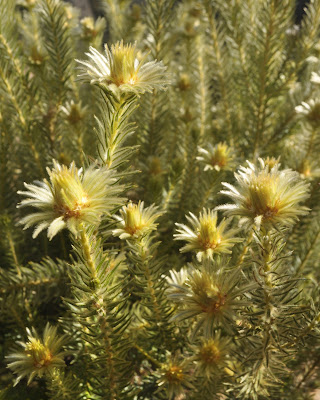
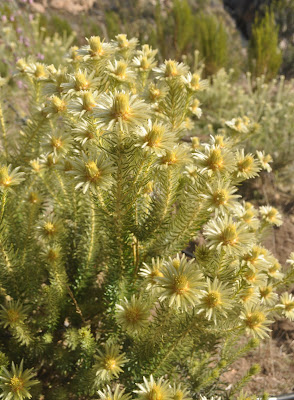
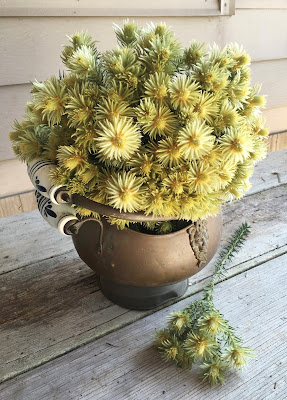
Phylica Pubescens or also called Featherhead is often thought of as a member of the Protea family but it’s actually part of the Rhamnacae family… both families are very closely related and an integral part of fynbos.


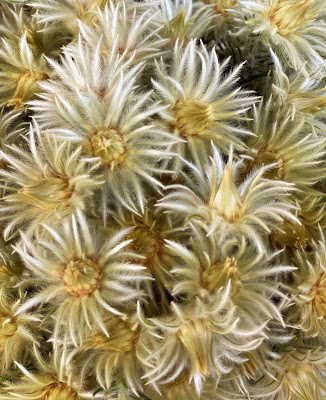
The name Pubescens refers to the short wispy white or yellow hairs on stems of this wonderful plant which at sunrise and sunset when back-lit seems to catch the sunlight and glow like magic.


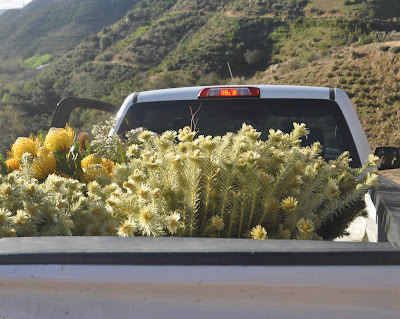
The common name Featherhead refers to the slightly cinnamon scented white flowers with gold overtones and dense feathery bristles that appear in clusters on top of the branches from mid-winter through spring. Below the flower heads are rings of soft feathery bracts that extend outward like golden-yellow whiskers. The tiny white flowers themselves are obsure amongst the feathery delight of the plant, but they can be seen when viewed up closely.


Tuesday, November 30, 2021

Serruria


This delightful genus of forty-four species from South Africa's Cape is a popular member of the Protea family. Serruria has received its connoisseur status among florists, designers and gardeners due to its rarity in nature and cultivation, as well as its exquisite blooms. Papery white and pink bracts surrounding feathery tufts of white to pinkish flowers are produced over winter and spring. Blushing Bride and 'Pretty ‘n’ Pink' are some of the most sought after and well-know varieties currently being grown.


Serruria 'Pretty ‘n’ Pink'


Serruria Blushing Bride

It is thought Serruria Blushing Bride received its name in South Africa because of its traditional use in bridal bouquets and through the custom of young men in the Cape Region wearing the flowers in a buttonhole of their jacket when courting. Unfortunately, Blushing Bride seems to have been over-exploited as the species was near extinction or even believed to be "lost" for 90 years in the wild until conservation measures in the 1960’s and 70's saved it.


When buying Serruria look for:
  1.  Bunches with 1/2 of the flowers open. 
  2. Avoid bunches with drooping blooms.

Flower Care:
  1. Keep cool when possible. 
  2. Split bunches and strip leaves from the bottom half of each stem. 
  3. Re-cut at least ¼” off the stems and place in cool water immediately. 
  4. Always use a preservative as it will help the buds to open. 
  5. Replace water frequently.

Friday, August 27, 2021

Leucadendron Argenteum


Did you know Leucadendron Argenteum or more commonly called Silver Tree has given its name to an entire genus of Proteaceae? The tree also divulges the obvious allure of this unique group – the splendor of its foliage. The name Leucadendron is derived from the Greek leukas meaning ‘white’ and dendron meaning ‘tree’.


Referred to as Silver Tree because its soft, elliptical leaves (which remain on the trees for years giving it evergreen status) are covered with hairs that look amazingly like silver in the sunlight and they shimmer in the wind. These trees can reach up to forty feet in height.

You don't know whether it is a male or a female until the day it flowers and shows off with large, pure silver egg-like cones (female) or yellow pollen surrounding small silver buds (male). The Silver Tree relies on wind for dispersing its seeds instead of having to attract birds or other dispersers. Each fruit looks like a small nut and is equipped with a "parachute". Once the seed is freed by strong winds, it can travel a considerable distance thanks to its design.

Silver Tree branches are stunning when used in arrangements and its individual leaves are ideal in corsages and boutonnieres.


Thursday, July 29, 2021

July Articles of Interest

50 Wedding Centerpiece Ideas We Love


As you're planning your wedding, you'll likely need to put some thought into how you'll decorate your reception. While most couples opt for floral arrangements—which they place in the center of their tables—the options extend far beyond simple bundles of one kind of bloom. With so many flower varieties out there, as well a whole spectrum of petal shades, choosing blossoms for your centerpieces can be overwhelming. Plus, not all brides and grooms want to use flowers at all—some choose to work with other elements, like candles. How can you decide on the right decorations for your celebration’s color scheme and theme?

Read more here.
_______________________________________________________

Fynbos: why fire is important for its survival

The ‘Cape Floral Kingdom’ is home to thousands of plants unique to South Africa, and while fynbos thrives after fire, ecologists feel there are vital lessons to be learnt from the flames.


South Africa’s Cape Floral Kingdom is the smallest but the most diverse: “There are approximately 9600 plant species in the Cape Floral Kingdom, and about 70% of them are found nowhere else in the world,” says van Wilgen. Most of this is fynbos, the hardy, shrubby plants with fine, small leaves, bulb plants and reeds that can be found from along the Cape’s coasts to mountain tops.

Ecologist Dr Jasper Slingsby explains that “fynbos and the Cape Floristic Region are the richest temperate flora in the world, making up roughly 3% of all known vascular plant species on the planet”.

Read more here.
_______________________________________________________

African Protea


Proteas were named after the Greek god Proteus, son of Poseidon, who had the ability to transform himself into many different shapes—and proteas do come in an astounding variety of shapes, sizes, hues, and textures. These plants are known for their unusual and beautiful flowers, which seem rather mythological themselves, like blooms from an alien landscape—some can reach 12 inches (30.5 centimeters) across. Proteas are considered to be among the oldest of flowering plants, and from the king protea Protea cynaroides to the tall silver tree Leucadendron argenteum to the nodding pincushion Leucospermum cordifolium, they have the allure of another time.

Read more here.
________________________________________________________

The Outside Story: How flowers get their color


To quote the French dramatist Jean Giradoux, “The flower is the poetry of reproduction. It is an example of the eternal seductiveness of life.” Flowering plants fill our summer fields and gardens, bring bright spots of color to our woods, and since their arrival on the scene some 130 million years ago have evolved along with animal life to become an essential part of the food web.

Read more here.

Saturday, November 28, 2020

November Articles of Interest

The one sure way to kill these beautiful,
hardy plants is with too much water and fertilizer


Some of the most glamorous plants for Southern California gardens come from a region whose soil is so poor in nutrients that fires are essential in providing fertilizer in the form of ashes for the existing flora. I am speaking about South Africa’s Cape floristic region. This area is more packed with endemic species than any other place on earth.

“Endemic” describes plants that are native to a specific place. Our own Channel Islands, for example, are famous for the seventy endemic species that grow there, and California has more endemic species than any other state. Yet the number of endemic species in the Cape floristic region — an area the size of Colorado — approximates the number of endemic species in all of North America.

Read more here.
________________________________________________________

The florist behind Melourne’s Urban Blooms project


What better way to celebrate a reawakening than with flowers. Capturing the spirit of Melbourne after months of lockdown is the huge floral display that Cherrie Miriklis-Pavlou of Flowers Vasette installed over the grand archway at the entrance of the iconic Flinders Street Station last Saturday.

The Flinders Street installation falls under the Urban Blooms project that is part of the $100 million Melbourne City Recovery Fund delivered by the City of Melbourne and the Victorian State.

Read more here.
________________________________________________________

Dried flowers are an Instagram obsession.
Here’s how to preserve, arrange and photograph them.


At first glance, Euclid Farm’s storefront might catch your eye as just another stylish Queen Street boutique, but look a little closer and you may be surprised at what you see. The shop window is filled with a display of dried flowers - and containers of dried blooms and grasses wrapped in bouquets of brown craft paper are the first thing you see when you step into the shop located directly across from Trinity Bellwoods Park.

Read more here.
________________________________________________________

Handcrafting Beautiful Bloom Arrangements


I have always loved the sight of a fresh, unique bouquet inside my home. Not only do flowers incite mood-enhancing qualities, but they also add just the right pop of color to a room. And while I enjoy my weekly routine of picking up premade bunches from a store, I thought it would be fun to learn how to create an arrangement using dried/preserved flowers, which are gaining popularity in home decor and at events. They’re also low maintenance since they don’t require changing of water and can be swapped throughout the seasons.

Read more here.

Saturday, October 24, 2020

October Articles of Interest


Petals by the Shore: American Grown at Home

Part Four of our Six-Part Series on
New Floral Marketing Models and Platforms


Wedding and event florist Kelly Shore, owner of Petals by the Shore in Damascus, Maryland, has spent the past five years educating herself about domestic flower sourcing. She began in her own backyard, motivated by a desire to support flower growers in her area, many of whom she originally purchased from through local farmers’ markets.

Read more here.
________________________________________________________

California Farmer Mel Resendiz


As we celebrate California Grown Farmer and Farmworker month, we want to highlight some very special farmers. First up, meet first-generation California farmer, Mel Resendiz.

Following a Dream of Farming

To Mel, being a farmer is more than just a job, it’s the fulfillment of a dream. “Being a farmer means that I have been able to achieve the American Dream.” said Resendiz “To own a business, own land, create jobs for family and others in the community, and to wake up every day doing something that I love doing.”

Read more here.
________________________________________________________

Sustainable use of land vital for fynbos protection


As the world looks for ways to tackle both an unprecedented health crisis and the ongoing climate crisis, the Flower Valley Conservation Trust in the Western Cape is working hard to bring to light the importance of fynbos protection through sustainable land use.

Established in 1991, the Flower Valley Conservation Trust is making sure that it creates a fynbos-filled future for life and livelihoods. The trust is a non-profit organisation based on Flower Valley Farm, just outside Gansbaai. It focuses on fynbos protection in natural landscapes and improving livelihoods across the fynbos biome.

Read more here.
________________________________________________________

The 62 Best Wedding Bouquets


A bride's floral arrangement is arguably the second most important part of her outfit, ranking immediately behind the wedding dress. Therefore, we encourage you to a put a lot of thought into the flowers you carry down the aisle! If you're wondering how to make your bridal bouquet extra special, it helps to turn to some inspiration. Luckily, we've got you covered with our all-time favorite arrangements. The bundles here feature some of the most creative shape, memorable shades, and beautiful flowers out there.

Read more here.