Wednesday, September 14, 2011

The Protea Attraction

The ability of protea to attract nectar-seeking birds is one of their greatest advantages. In South Africa’s Cape Floral Kingdom protea are primarily bird-pollinated, and it is common to see the beaks and heads of birds covered in pollen that is being efficiently transferred between flowers.

In addition, protea are an excellent food source, especially over the long winter months. In the Cape Floral Region, Cape Sugarbirds are seldom found far from the Proteaceae, especially in the early morning when nectar flows in abundance attracting a multitude of insects which in turn attract the Sugarbirds. Each bird has its own personal bush which it guards jealously from the other Sugarbirds. For the artist or photographer, these birds are a welcome subject since they do not flee at the sight of a human being.

Here are a few of my favorite bird and protea photographs - Enjoy!!!


Sunday, August 28, 2011

A Passion for Farming and The Earth

I have always had a passion for farming! I’ve harvested cotton, cut sugarcane, planted tomatoes and now, I’m a flower farmer (with a small vegetable garden and some fruit trees in between), and I absolutely love it!


As a flower farmer, I have come to realize how important it is to take good care of my land by preventing erosion and mulching to enrich and protect the soil from dehydration or loss of water. Water is precious here in S. California, without it there would be no locally grown flowers to enjoy, and that is why I use a drip system to irrigate my plants. This type of system conserves water by dripping just enough water around each plant to feed only its roots.


In addition, Resendiz Brothers has become Veriflora certified; and I am always looking for new and creative ways to conserve and protect my land and the environment, so my family can keep growing high quality flowers and foliage for years to come!

Sunday, August 21, 2011

Rainbow

What’s the first thought that comes to your mind when someone mentions the word Rainbow? Most often, it’s a beautiful arc of colors formed by sunshine on rain! However, for me, Rainbow is much more then sunshine on rain, it’s the place where I grow my flowers, my protea – Rainbow, California.
A rainbow over Rainbow

Rainbow is a quaint and very colorful agricultural community. It seems like there’s a greenhouse full of gorgeous plants or a nursery with a rainbow of color packs ready for planting on every corner. This small community of nearly 1900 neighbors has one restaurant, gas station, school, florist and two country markets. On any given day, it’s not uncommon to see my pickups loaded with flowers navigating though the windy roads. Sometimes it looks like I have yanked a fireworks display out of the sky and tossed it in the back on my truck – almost a one pickup parade. But funny enough nobody gives it a second glance – it’s just another day in Rainbow or as I see it, another day in paradise!


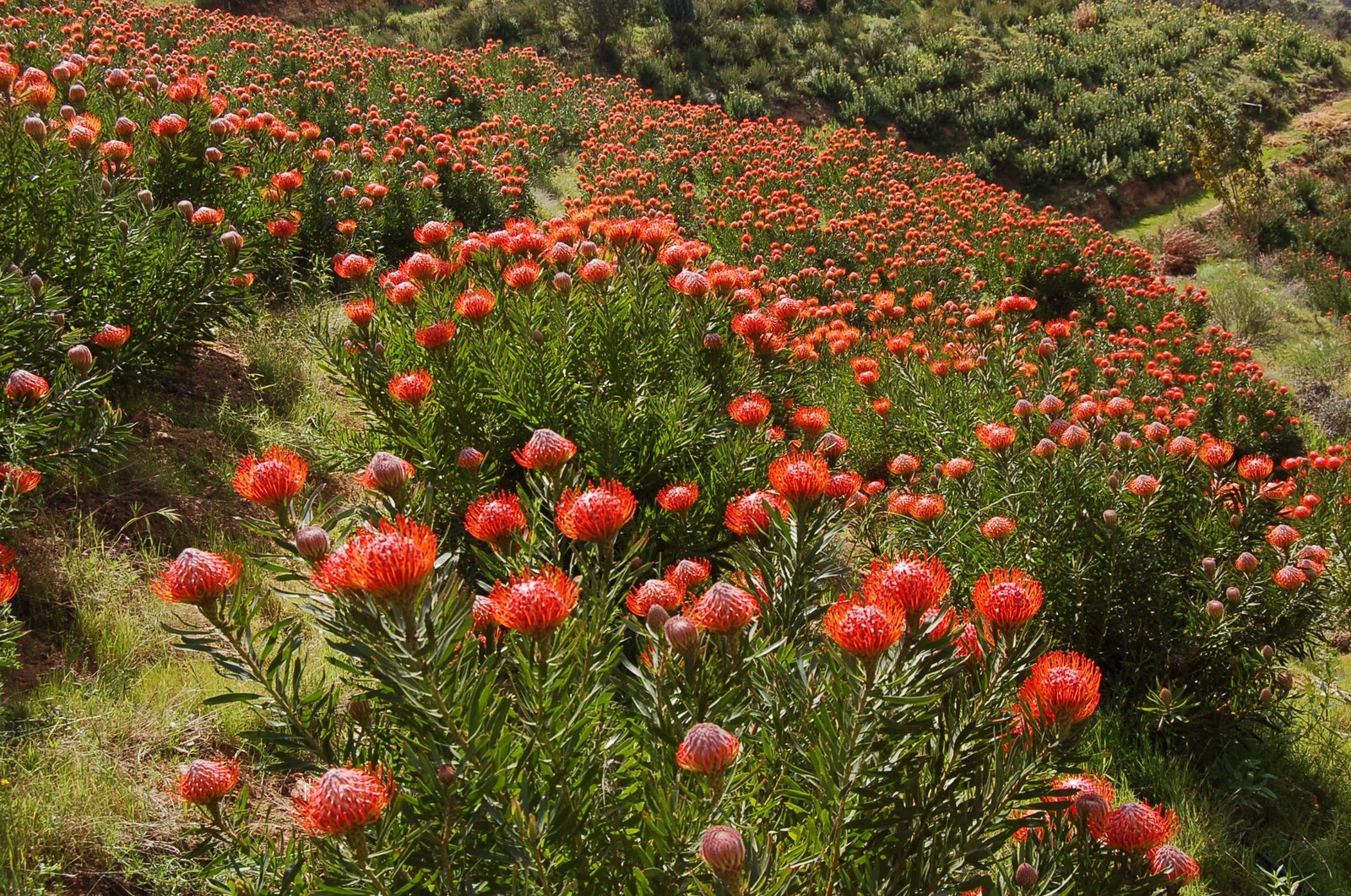
Then, there’s that place “Somewhere over Rainbow way up high” where my proteaceae grow! Yes, these little known Southern Hemisphere Natives flourish in this particular area of S. California, bless with warm days, cool nights, dry summers and cool ocean breezes - the perfect Mediterranean climate for my special flowers. My protea plants are constant reminders that earthly life is both powerful and glorious. The earth itself produced these amazing blooms, using simple materials such as crumbed granite, lots of sun, and an occasional drink of water – my flower fields in these hills above Rainbow is where I’ve found my barrels of gold, my happiness, my life!


Sunday, July 31, 2011

Summer in the Fields

During the month of July it feels a bit like taking an "intermission" - some flowers and foliage are leaving the fields and others are preparing to come on. July is a quiet time here on the farm and it provides us a sampling of the flowers soon to rest and others getting ready to bloom. The colors, textures and sights of summer certainly warm the soul and delight the eye!


This is the month when we see our beloved pincushions, colorful filler flowers and exotic kangaroo paws start to taper off and slowly vanish from the fields. We find ourselves cherishing every last bloom, knowing it will be months before we finally see them revisit.


July, is the month when our mysterious, almost alien looking brunia albiflora is ready to harvest. Brunia is truly a summertime favorite for many florist and designers, adding that interesting texture and unusual touch to any arrangement.


This is also the time of the year when we see a new season begin. Protea plants are showing their first blooms and the leucadendron are taking on their deep red and burgundy tones. We find ourselves waiting with anticipation, as the fields slowly start to show their flowers and fill with color once again.


So, as this month concludes, it is apparent there is truly a circle of life in nature too!

Sunday, May 15, 2011

Kangaroo Paws

An unusual botannical from the Land Down Under

     There are few flowers that offer as much vivid color, distinctive form and unusual texture as kangaroo paws. Anigozanthos (pronounced an-ih-go-zan-thos) or more commonly known as “K-Paws” produce clusters of wooly tubular blossoms that do indeed resemble kangaroo toes. The size of the flowers, stem length and color vary depending on the species and cultivar.

      These are truly colorful kangaroo toes, ranging in color from black and green to Christmas red, orange, yellow, burgundy with over 40 varieties now on the market. They can grow to heights of five feet or more allowing them to survive well in the forest where they can thrust their colorful flowers above the undergrowth, advertising nectar to the birds that pollinate them. In addition, K- Paws have a sturdy stem, which is a natural perch and makes them ideal flowers for birds. The Kangaroo Paw's shape and the position of the pollen-bearing anthers enable pollen to deposit on the head of the feeding birds. Pollen is transferred from flower to flower as the honeyeaters or wattlebirds feast. Interestingly enough, these flowers have no fragrance but all flying creatures love them anyway.

      The decorative value of the kangaroo paw lies in the color and texture of these flowers. They grow in clusters and are slender rather than voluminous. For this reason many designers use K-Paws as line material. Some varieties are fuller and more branchy than others, with a structure like hat trees, adding further interest to the long stems and fingerlike flowers.  And here are a few of our favorite varieties.

Assorted Kangaroo Paws

Orange Kangaroo Paw

Orange & Green Kangaroo Paw

Red Kangaroo Paw

Black & Green Kangaroo Paw

Black & Green Kangaroo Paw with Orchids and Fern Leaf

Yellow and Red Kangaroo Paws in landscaping
     

Wednesday, March 23, 2011

Leucospermum - Pincushions

Leucospermum are some of the most popular members of the Proteaceae family and easily recognized by their flower-heads with long, conspicuous styles, each one thickened at its apex to form a pollen presenter. Together, the mass of styles look like pins bristling from a pincushion, a similarity that has given rise to the popular name for these Proteas. So appropriate is the name “Pincushion Protea” that it has in fact replaced the original South African name of “Luisies” which refers to the grayish-white, rounded seeds found crumpled in the dried flower-heads, resembling insects in tangled in the fur of an animal.

Leucospermums are not only popular for their beautiful flowering heads, but the plants are also easily cultivated and make wonderful garden shrubs. They are fast growing and can produce a fabulous display of yellow, orange or red blooms for years when grow under the right conditions.

Did you know that Pincushions flower is the spring to suit the insects?  The seeds are mature in the summer and are released when the ants are most active and likely to disperse them.

There are currently over 48 varieties of Leucospermum available throughout the world, a number that will continue to grow as new hybrids are created and marketed.


Pincushion Tango Plants

Pincushion Flame Giant


Pincushion Hawaii Gold

Pincushion Tango

Pincusion Erubescens


Pincushion Starlight

Pincushion Sunkist


Sunday, February 20, 2011

Serruria

This delightful genus of 44 species from South Africa's Cape is a popular member of the Protea family. Serruria flowers in the springtime producing papery white and pink bracts, or floral leaves, surrounding feathery tufts of white to pinkish flowers. Blushing Bride and Sugar ‘n’ Spice are well-known varieties with their delicate and dainty white, pink and rose flowers.

It is thought Serruria "Blushing Bride" received its name in South Africa because of its traditional use in bridal bouquets and through the custom of young men in the Cape Region wearing the flowers in buttonholes when courting. Unfortunately, "Blushing Bride" seems to have been over-exploited as the species was near extinction or even believed to be "lost" for 90 years in the wild until conservation measures in the 1960’s and 70's saved it.


Serruria "Sugar 'n' Spice" is also a popular variety among florist for its use in posies, boutonnieres and corsages. In addition, it has become a very popular potted plant in Australia.


These treasured flowers are now being grown in South Africa, Australia, Israel and the US, including Hawaii.