Showing posts with label Western Australia. Show all posts
Wednesday, March 29, 2017
Instagram: Photos We Dig
Ten fabulous photos from Yelverton Protea Farm - Established and hand planted by the Thorpe family in 1988. Centrally located between the south-west capes in the Margaret River Wine Region of Western Australia, Yelverton farms over two hundred acres of undulating fields nurtured by the Island Brook creek.
Labels:
Arrangements,
Bouquets,
Flower Farmer,
Harvest,
Inspiration,
Instagram,
King Protea,
Leucadendron,
Leucospermum,
Margaret River Wine Region,
Nursery,
Passion,
Protea Farm,
Thorpe Family,
Western Australia,
Yelverton
Wednesday, October 28, 2015
Dryandra
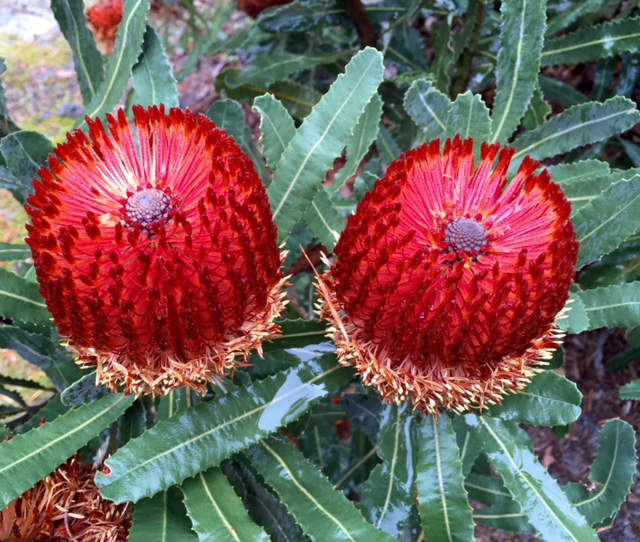
Dryandras are closely related to the Banksias, Grevilleas and Hakea, and like many proteas they have lots of individual flowers clustered into a globe-shaped inflorescences. Some blooms open up like a shaving brush, while others appear to be closed with individual outer bracts. Their colors are usually limited to bronze, yellow and maroon. The foliage can be very erratic, some have very narrow leaves with small jagged edges, others a coarse, fishbone look, or even large leaves like banksias. There are over 90 known varieties of Dryanda all of which are native to Southwestern Australia.
An interesting fact: Dryandra seeds are only released during a bushfire or when the plant dies.
Dryandra Formosa
Dryandra Polycephala
Dryandra Quercifolia
Dryandra Borealis
Dryandra Praemorsa
Dryandra Nivea
An interesting fact: Dryandra seeds are only released during a bushfire or when the plant dies.
Sunday, August 30, 2015
XVII International Protea Association Conference
With the beautiful backdrop of Western Australia’s unique flora, and coinciding with the 50th anniversary of the world-renowned Kings Park, the XVII International Protea Association Conference held in Perth was truly inspiring. The educational programs were rich and varied, with speakers from around the globe discussing new ornamental species, breeding, cultivation, post-harvest handling and marketing plus exciting new developments in the Proteaceae and Australian wildflower industries.
The first two conference days included presentations by four highly acclaimed keynote speakers and concurrent sessions focused on Proteaceae and new ornamental crops. The third and fourth days were devoted to visiting commercial wildflower farms and nurseries, a leading wildflower exporter, and a guided tour of Kings Park, including a look ‘behind the scenes’ at the nursery and research programs.
Commercial Wildflower
Kings Park and Botanical Garden
However, the conference wasn’t only about learning – there was plenty of time to network with fellow flowers farmers from around the world.
The XVIII International Protea Association Conference is tentatively scheduled for August 2017 in Stellenbosch, South Africa.
Friday, August 28, 2015
The Business of Banksia
There’s only one spot in the world where all 79 species of Banksia in existence grow and that’s in Kevin and Cathy Collins’ delightful five-hectare garden in Mount Barker, Western Australia. Kevin, who is also known as the ‘Banksia Man’, owns and runs The Banksia Farm in this sleepy wine-growing region of Australia. Kevin claims, “This was never a planned business, it’s a hobby gone mad.”
Kevin educates everyone from visiting school kids to botanists. “I don’t have a day’s botanical training,” he says. “I was just over in America lecturing on it.” He is the co-author of books on botany and is valued as an expert on Western Australia’s wildflowers in particular. As well as holding the most recently found banksia, the garden also has many of the world’s species of dryandra, which are closely related.
Kevin says the climate of Mount Barker has helped them grow all 79 species of banksia. The other thing that assisted them is the huge variety of soils. “We have everything from pH 4.5 to 6.5, and by moving them around we were able to mix and match and grow them all.”
Kevin is quite animated as he explains why he loves banksias. “Many are killed by fire, and yet they’ve been around for 50-70 million years, he says. “They’re so diverse. Some need fire and follow-up rains to release seeds. And historically they’ve been used for so much.”
Kevin educates everyone from visiting school kids to botanists. “I don’t have a day’s botanical training,” he says. “I was just over in America lecturing on it.” He is the co-author of books on botany and is valued as an expert on Western Australia’s wildflowers in particular. As well as holding the most recently found banksia, the garden also has many of the world’s species of dryandra, which are closely related.
Kevin says the climate of Mount Barker has helped them grow all 79 species of banksia. The other thing that assisted them is the huge variety of soils. “We have everything from pH 4.5 to 6.5, and by moving them around we were able to mix and match and grow them all.”
Bronze Menziesii
Oak Leaved Banksia
Occidentalis
Coccinea
Menziesii
Coastal Banksia
Kevin is quite animated as he explains why he loves banksias. “Many are killed by fire, and yet they’ve been around for 50-70 million years, he says. “They’re so diverse. Some need fire and follow-up rains to release seeds. And historically they’ve been used for so much.”
Thursday, August 27, 2015
Wild Flowers of the Western State
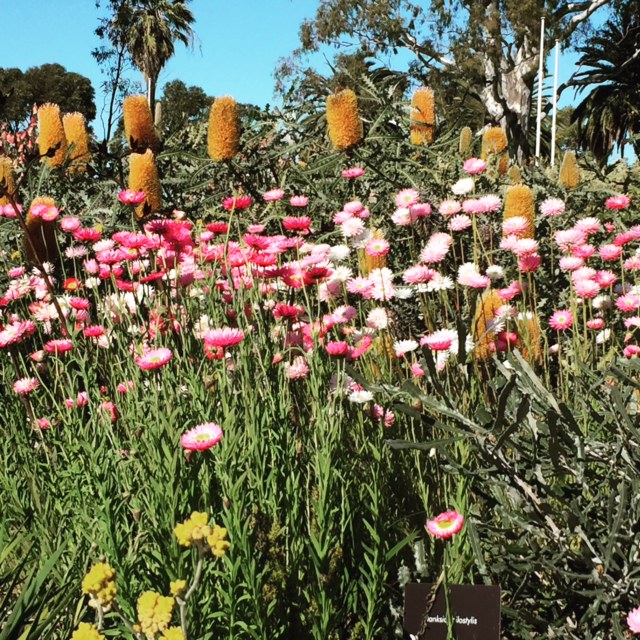
Western Australia is one of the richest wildflower areas in the world. Its great wealth lies not only in the large number of different species to be found but also in the great diversity of the size, shape, color, texture and form between individual flowers.
There are over 8000 native plants in Western Australia with another 800 that have been introduced from other states or countries. In addition, a high percentage of native species are endemic, and found only in this part of the world. This is particularly so in the southwest portion of the state where it is estimated between 75% - 85% of the known wildflowers grow only within this small region and nowhere else on earth. Many of the flowers can truly be described as ‘unique’. The Kangaroo Paws, Bottlebrush, Grevilleas, Isopogons, Everlastings, Dryandras, and many of the Banksias and Waxflowers are botanical curiosities attracting international scientific interest.
From late summer through early spring (August and October), numerous exhibitions and festivals are held throughout the state by local enthusiasts to showcase and celebrate the wildflowers of the particular region. These festive events provide a fun and colorful way for both locals and visitors to gain an appreciation of the diversity of Western Australia’s flora.
Wildflower Displays in Kings Park and Botanical Garden
There are over 8000 native plants in Western Australia with another 800 that have been introduced from other states or countries. In addition, a high percentage of native species are endemic, and found only in this part of the world. This is particularly so in the southwest portion of the state where it is estimated between 75% - 85% of the known wildflowers grow only within this small region and nowhere else on earth. Many of the flowers can truly be described as ‘unique’. The Kangaroo Paws, Bottlebrush, Grevilleas, Isopogons, Everlastings, Dryandras, and many of the Banksias and Waxflowers are botanical curiosities attracting international scientific interest.
From late summer through early spring (August and October), numerous exhibitions and festivals are held throughout the state by local enthusiasts to showcase and celebrate the wildflowers of the particular region. These festive events provide a fun and colorful way for both locals and visitors to gain an appreciation of the diversity of Western Australia’s flora.
A Taste of Chitterinng Festival Flowers
Labels:
Australian Native Flowers,
Banksia,
Botanical Garden,
Bottlebrush,
Color,
Dryandras,
Everlastings,
Grevilleas,
Isopogon,
Kangaroo Paw,
Kings Park,
Texture,
Unique,
Waxflower,
Western Australia,
Wildflowers
Subscribe to:
Posts (Atom)